 FIG. 48
Why I own two life insurance policies (and why I bought them young)
One protects my family if I die. The other works for us while I live.
I carry a $1M term policy and a New York Life whole life policy — one for the worst case, one for emergencies, a kitchen upgrade, and retirement dividends. Here's my thinking, plus the real tax rules.
This is my personal setup and my reasoning — not financial advice. Insurance is one of those decisions where your family situation changes everything, so treat this as one data point from my journey.
I don’t talk about this part of my finances much, but it’s honestly the foundation everything else sits on. Before I sold a single put or chased a single deal, I made sure of one thing: if something happens to me, my family is okay. At least financially.
So I own two life insurance policies, and they do two completely different jobs.
Policy #1: Term life — the “if I die” policy
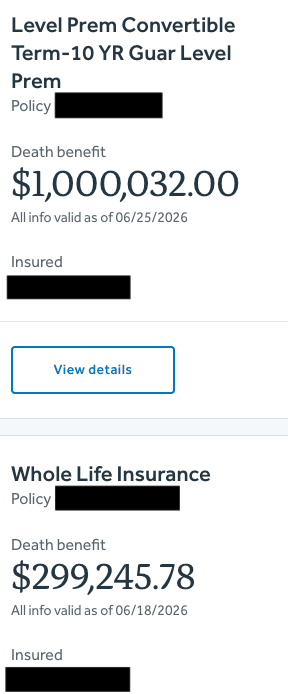
My first policy is a 10-year guaranteed level premium convertible term policy with a $1,000,032 death benefit. In plain English: for 10 years, my premium never goes up, and if I die during that time, my family receives a million dollars.
That’s it. That’s the whole product. There’s no cash value, no investment component, no dividends. It’s pure protection, and because of that, it’s cheap — term life is by far the most death benefit you can buy per dollar, especially when you’re young and healthy.
I have young kids. If I’m gone, that million dollars is the mortgage, the groceries, the years my wife would need to breathe, and a real shot at college for the kids. I don’t think of the premium as an expense. I think of it as the price of knowing my family’s life doesn’t collapse financially on the worst day of their lives.
One detail I made sure of: mine is convertible, which means I can convert some or all of it into a permanent policy later without a new medical exam. That’s a quiet superpower. If my health ever changes, my insurability is already locked in.
Policy #2: Whole life — the “while I live” policy
My second policy is a New York Life whole life policy with a $299,245 death benefit — but honestly, the death benefit is not why I bought it.
I bought it because whole life builds cash value — money inside the policy that grows over time and that I can actually use while I’m alive. The way I think about it, this policy has three jobs:
- Big trouble. If we ever get into a serious emergency, I can borrow against the cash value — no bank application, no credit check, no explaining myself to a loan officer.
- Big upgrades. When we’re ready to redo the kitchen, that’s another moment this policy can fund. Borrow against it, renovate, pay it back on my own schedule.
- Retirement, around 65. New York Life is a mutual company, which means policyholders like me are eligible for dividends. They’ve paid them every single year for over 170 years — through the Great Depression, through 2008, through everything. Dividends are not guaranteed, and I want to be straight about that, but that track record is a big part of why I chose NYL. By retirement, those dividends and the accumulated cash value become a supplemental income stream.
So while my term policy protects my family from the worst case, my whole life policy quietly works for us in every other case.
Is the money really tax-free? (I checked)
I used to just say “it’s tax-free money,” but I did my homework, and the honest answer is: it’s tax-advantaged — and tax-free if you use it correctly. Here’s the real breakdown:
- The death benefit is income-tax-free to your beneficiaries. This one is true, full stop, for almost everyone. If I die, my family does not pay income tax on that money.
- The cash value grows tax-deferred. No tax bill while it compounds inside the policy.
- Policy loans are tax-free — as long as the policy stays in force. This is how the kitchen upgrade gets funded without a tax hit.
- Withdrawals are tax-free up to what you’ve paid in premiums. Above that, gains get taxed as income.
- Dividends are treated as a return of premium, so they’re generally not taxed until everything you’ve received exceeds everything you’ve paid in.
The one trap to know: if you borrow heavily and then let the policy lapse, the gains can suddenly become taxable. The tax advantages reward people who keep the policy healthy — which is exactly how I intend to treat mine.
Why I bought young (and think you should consider it too)
Life insurance is one of the very few things in personal finance where being young is a massive financial advantage. Two reasons:
Price. Premiums are based on your age and health at purchase. Every year you wait, the same coverage costs more — forever. My rates are locked at the age and health I had when I signed, and that discount compounds for decades.
Insurability. This is the one people miss. You don’t buy life insurance when you need it — you buy it when you can. One diagnosis, one bad blood panel, and coverage gets expensive or impossible. Buying young and healthy means you locked the door before the storm, not during it.
The honest caveats
I believe in this setup, but I’d be doing you a disservice if I didn’t say this part out loud:
- Whole life is expensive compared to term — often 10x or more for the same death benefit. That’s the price of the cash value and permanence.
- Cash value grows slowly in the early years. The first several years, most of your premium goes to costs, not savings. This is a decades game, not a five-year one.
- It only works if you keep it. People who surrender whole life policies in the first 10 years usually lose money. If your budget can’t comfortably carry the premium for the long haul, term alone is the smarter buy.
- “Buy term and invest the difference” is a legitimate alternative. Plenty of smart people run that playbook instead. I chose to do both — big term for protection, whole life as a conservative, tax-advantaged layer alongside my investing — because I wanted guarantees my brokerage account can’t give me.
Bottom line
My term policy is a promise to my family. My whole life policy is a promise to my future self. Neither one is exciting, neither one will 10x, and that’s exactly the point — this is the boring, load-bearing floor under everything else I do on this journey.
If you have people depending on your income and you’re young and healthy, at minimum, price out a term policy this week. It’s cheaper than you think, and the you of ten years from now — or the family of ten years from now — will be glad you did.
Again: this is my personal situation, not advice. Talk to a licensed insurance professional (and ideally a fee-only advisor who doesn’t earn a commission) before buying any permanent life insurance — policy details, riders, and your family’s needs matter enormously.
- Term life death benefit $1,000,032
- Whole life death benefit $299,245
- NYL consecutive years paying dividends 170+ yrs