 FIG. 86
Can You Borrow Against Stocks to Buy a House? I Sold Instead — Here's What It Cost Me
In 2023 I liquidated almost my entire portfolio for a down payment. Then I learned about the tool the wealthy use — and why it wouldn't have worked for me anyway.
You can borrow against a brokerage account instead of selling it — it's called a securities-backed line of credit. Here's the real math, the minimums nobody mentions, and why my own mistake cost me market exposure, not taxes.
In 2023 my wife and I bought the house we live in now. To get to the down payment, I sold almost every single stock in my portfolio — around $50,000 worth. Basically all of it.
I didn’t know securities-backed lines of credit existed at the time. If I had, I don’t think I would have sold a share. That $50,000 would be more than $100,000 today by my rough math.
That’s the confession. Now here’s the part that took me longer to admit: even if I’d known, it wouldn’t have worked. Not at my size. And figuring out why taught me more than the original regret did.
The thing rich people do instead of selling
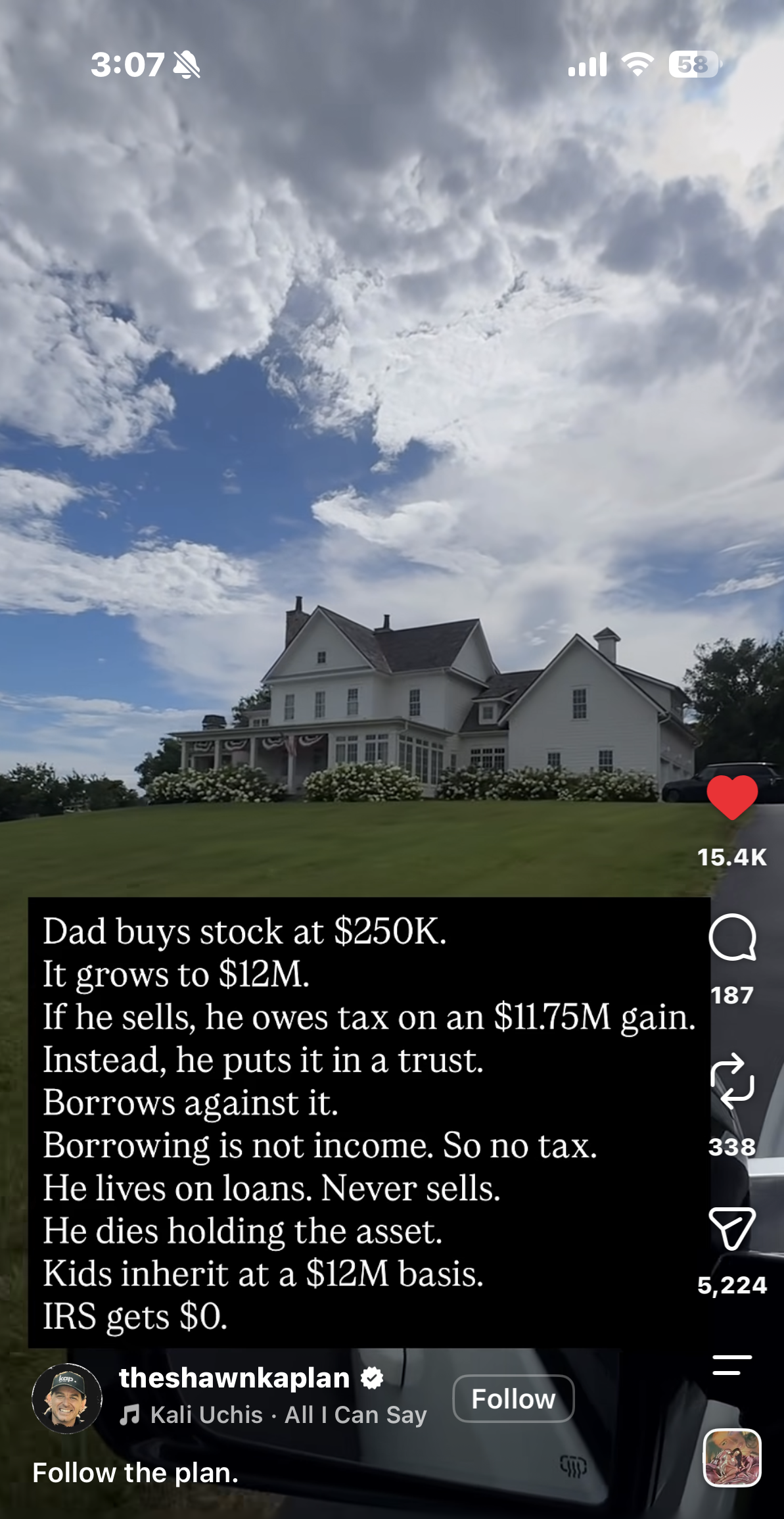
The pitch you’ve probably seen on social media goes like this. You have $1 million in stock. You want a $1 million house. Everyone else sells $200,000 to cover the 20% down and eats a tax bill. The wealthy don’t sell — they borrow against the portfolio instead, walk into closing owing nothing to the IRS, and leave the whole $1 million compounding.
The tool is real and it has a boring name: a securities-backed line of credit, or SBLOC. Depending on the brokerage you’ll also see it called a pledged asset line or a liquidity access line. Same idea.
Here’s how it actually works. You pledge the stocks, ETFs, and bonds in a taxable brokerage account as collateral. The lender opens a revolving credit line against them. Advance rates typically run 50% to 75% on a diversified equity portfolio — so a $1 million account might support $500,000 to $750,000 of borrowing power. You draw what you need, you pay interest only on what you’ve drawn, and there’s usually no fixed repayment schedule.
One hard rule: the money can be used for almost anything except buying more securities. Real estate is a normal, allowed use. Fidelity’s own materials list buying or renovating real estate right alongside a wedding, tuition, or a tax bill.
So the mechanism is legitimate. It’s the math around it that gets oversold.
The illustrative math, done honestly
Let me run that $1 million example properly. These are illustrative numbers, not mine — I’ll get to my real ones below.
If you sell $200,000 of stock: you owe tax on the gain, not the sale amount. That distinction gets mangled constantly. If your cost basis is 50%, the gain is $100,000, and federal long-term capital gains tax at 15% is about $15,000 — maybe $19,000 once the 3.8% net investment income tax kicks in. Not the $40,000 you’ll see quoted, which quietly assumes a zero cost basis and the top rate.
If you’re in Washington, it’s even less. The state levies 7% on long-term gains above a standard deduction of $278,000 for 2025 — indexed annually, with the 2026 figure not yet published. A $100,000 gain doesn’t come close. Washington charges you nothing.
If you borrow $200,000 instead: SBLOC rates in May 2026 ran roughly 5.80% to 7.95% across major brokers — SOFR around 4.30% plus a spread of 1.50% to 3.65% depending on balance and lender. Call it 6.5%. That’s $13,000 a year in interest.
Now the comparison people get wrong. Selling leaves you $800,000 compounding instead of $1 million. The difference isn’t growth on the whole million — it’s growth on the $200,000 you didn’t sell. At 10%, that’s $20,000 a year.
$20,000 of extra growth, minus $13,000 of interest, is about $7,000 a year of edge. Real. Worth understanding. But it’s a spread trade, not free money — and it only works while your portfolio out-earns your loan.
Three things the hype posts leave out
You didn’t skip the tax. You deferred it. Sell later to pay down the line and the IRS is still standing there. The only version where the tax genuinely disappears is the one where you die holding the shares and your heirs get a stepped-up basis. That’s the actual engine behind “buy, borrow, die,” and it’s worth saying out loud instead of implying the bill evaporates.
The interest isn’t deductible. Borrow against stocks to buy a personal residence and it’s not investment interest, because the proceeds didn’t go into investments. It’s not mortgage interest either, because the loan isn’t secured by the house. So 6.5% is a full 6.5%, with no tax shield underneath it.
The rate floats. Every major SBLOC product is floating-rate and resets monthly with SOFR, so a Fed move flows through within 30 to 45 days. Whatever rate you sign at is a snapshot, not a term.
The risk that ends the party
The single biggest risk is the maintenance call: if your portfolio falls below the lender’s threshold, you deposit cash or accept forced liquidation.
Read that again, because it’s the whole ballgame. In a bad enough drawdown, the broker sells your positions — at the bottom, on their schedule, not yours. It’s the exact scenario every long-term investor spends their life trying to avoid, except now it isn’t your choice.
Borrowing $200,000 against $1 million is only 20% loan-to-value, which is genuinely conservative — you’d need a catastrophic decline to get called. But notice what you’ve built: an 80% mortgage on the house, a callable loan covering the other 20%, and zero equity cushion anywhere. You are 100% levered on the property while carrying a demand loan on top. In a good decade that’s brilliant. In 2008 it’s a story people tell about you.
And not everything qualifies as collateral — illiquid or volatile holdings may be excluded outright, which limits how much you can actually borrow.
The part almost nobody mentions: your mortgage lender
This one surprised me. Using borrowed money for a down payment is allowed — Fannie Mae’s guideline B3-4.3-15 says borrowed funds secured by an asset are an acceptable source for down payment, closing costs, and reserves, and financial assets like stocks and bonds count as qualifying collateral.
But there’s a price. The lender must count the monthly payment on that secured loan as debt when qualifying you. And if you’re also counting that same portfolio as reserves, its value gets reduced by the amount you borrowed against it.
Translation: the SBLOC shrinks how much house you qualify for. You solved the down payment and made the approval harder in the same move. Run your numbers through the mortgage calculator both ways before you assume this is free.
So why wouldn’t it have worked for me?
Here’s where my regret ran into arithmetic.
Minimum portfolio sizes for an SBLOC run $100,000 to $250,000. Schwab, for instance, may require you to pledge a minimum dollar amount — $100,000 is a typical figure. My whole taxable portfolio in 2023 was around $50,000.
Even in a fantasy where someone took me as a client, a 50-75% advance rate on $50,000 is $25,000 to $35,000 of credit. That doesn’t cover a down payment in the Seattle area. It doesn’t come close.
And the rate would have been ugly. SOFR hit an all-time high of 5.40% in December 2023. Add a typical 2-3% spread and I’d have been borrowing at 7.5% to 8.5% — against a portfolio I was hoping would outrun it.
So the honest version of my mistake isn’t “I didn’t know about SBLOCs.” It’s this: I was below the threshold where the sophisticated option even becomes available. The tool exists at $250,000. It doesn’t exist at $50,000. That’s not a secret being kept from regular people so much as a floor most of us haven’t crossed yet.
What it actually cost me — and it wasn’t the tax
Everyone writing about this sells the tax angle. At my size, the tax angle was almost irrelevant. Washington charged me nothing. Federal tax on whatever portion of that $50,000 was gain was a small number.
What cost me was three years out of the market. That $50,000 would be north of $100,000 today by my estimate. The expensive thing wasn’t a tax bill — it was selling my compounding to buy a roof.
That’s the lesson I’d actually hand someone: when you’re deciding whether to liquidate for a house, run the opportunity cost, not the tax cost. The tax is a one-time bill you can size in an afternoon. The forgone growth is the one that keeps charging you.
Would I do it differently now?
Yes — with conditions.
If I needed money today for a house or something similarly large, I’d borrow against my stocks rather than sell them, as long as I expect the return to beat the interest. That’s the test. Not “debt is bad,” not “never sell,” just: does the money I keep invested earn more than the money I’m renting?
But I have to name the thing that makes me a bad candidate for my own advice. My portfolio is over half NVDA, plus a 3x leveraged semiconductor ETF. That’s not the diversified collateral base those 50-75% advance rates assume. A lender would haircut me hard, and the leveraged fund likely wouldn’t count as collateral at all. Worse, the drawdown that triggers a maintenance call in a concentrated semiconductor portfolio is exactly the drawdown that hits everything I own at once — the collateral and the conviction fail on the same day.
So I’ll say the useful version rather than the flattering one: an SBLOC is a diversified-portfolio tool, and I don’t have a diversified portfolio. If I want to use one properly, the fix isn’t a better broker. It’s fixing my concentration first.
Right now every dollar of debt I carry is on the house. I’m not in a rush to change that until the collateral underneath a line of credit is something I’d trust in a bad quarter.
The honest summary
- Borrowing against stock instead of selling is a real, legal, unremarkable tool. It’s not a loophole.
- It defers tax, it doesn’t erase it — the erasure only happens at death via stepped-up basis.
- The interest isn’t deductible for a home purchase, and the rate floats with SOFR.
- The maintenance call is the risk that matters, and concentrated portfolios are the worst candidates.
- Your mortgage lender counts the payment against you and discounts your reserves.
- And there’s a minimum. Below roughly $100,000 in a taxable account, this isn’t a decision you get to make.
If you’re under that threshold and staring at a down payment, don’t let a social media post convince you that you’re missing a secret. You’re not. You’re just early. Keep compounding, and revisit this when the portfolio is big enough that the question is real.
Not financial advice — this is my own experience and my own math, and I got the original decision wrong. SBLOC rates, minimums, and advance rates vary by brokerage and change constantly; the figures here reflect published rates as of mid-2026 and should be verified directly with your broker before you commit to anything. Washington’s capital gains standard deduction is the 2025 amount, indexed annually, and the 2026 figure had not been published at the time of writing. Borrowing against a concentrated portfolio carries forced-liquidation risk that no interest rate comparison captures. Talk to a CPA about your own tax situation before making a decision of this size.
- Stock I sold in 2023 ~$50,000
- What it'd be worth now (my estimate)
$50,000$100,000+ - Typical SBLOC minimum portfolio $100,000–$250,000
- Typical SBLOC rate, mid-2026 5.80%–7.95%