The BYD Lesson Everyone Gets Wrong — and What It Really Means for the DeepSeek Threat
The market story that aged terribly — and is about to repeat
Investors love the story that Tesla beat BYD on quality. The 2025 data says otherwise — and if you apply the real BYD lesson to DeepSeek honestly, the conclusion is more uncomfortable (and more investable) than the popular take.
Microsoft made a quiet announcement last month that should have gotten a lot more attention than it did: the company told Axios it is exploring a fine-tuned, Azure-hosted version of DeepSeek V4 — yes, the Chinese open-source model — as a lower-cost engine for Copilot Cowork, its enterprise AI agent. At the same time, Microsoft is moving Copilot Cowork to usage-based pricing, because the current generation of agentic AI tools burns through so much compute that flat-rate plans stopped making financial sense.
My first reaction was the same one a lot of investors had: this is Tesla vs. BYD all over again.
A scrappy Chinese competitor shows up with a product that’s dramatically cheaper. The incumbent’s shareholders panic. And then — in the version of the story most American investors remember — the market realizes the cheap alternative isn’t actually as good, everyone goes back to the premium product, and the incumbent wins.
I was halfway through outlining that exact article when I did what I always tell you to do before putting money (or your byline) behind a thesis: I checked the numbers.
The numbers told a different story. And honestly, the real BYD lesson is far more useful for thinking about the AI market than the comfortable one.
The story we tell ourselves about Tesla and BYD
Here’s the popular narrative, and I’ll admit I believed a version of it myself:
Around 2023–2024, BYD announced cheaper EVs and briefly outsold Tesla. Tesla’s stock tanked because shareholders feared the competition. But BYD’s build quality “wasn’t even close,” buyers figured that out, and the market’s attention swung back to Tesla. Premium American engineering beat cheap Chinese scale. The end.
It’s a satisfying story. It flatters the incumbent, it flatters American manufacturing, and it gives investors a tidy template: when a cheap Chinese competitor shows up, buy the dip on the quality leader.
There’s just one problem.
What actually happened
BYD won. Not on vibes — on volume, and by a landslide.
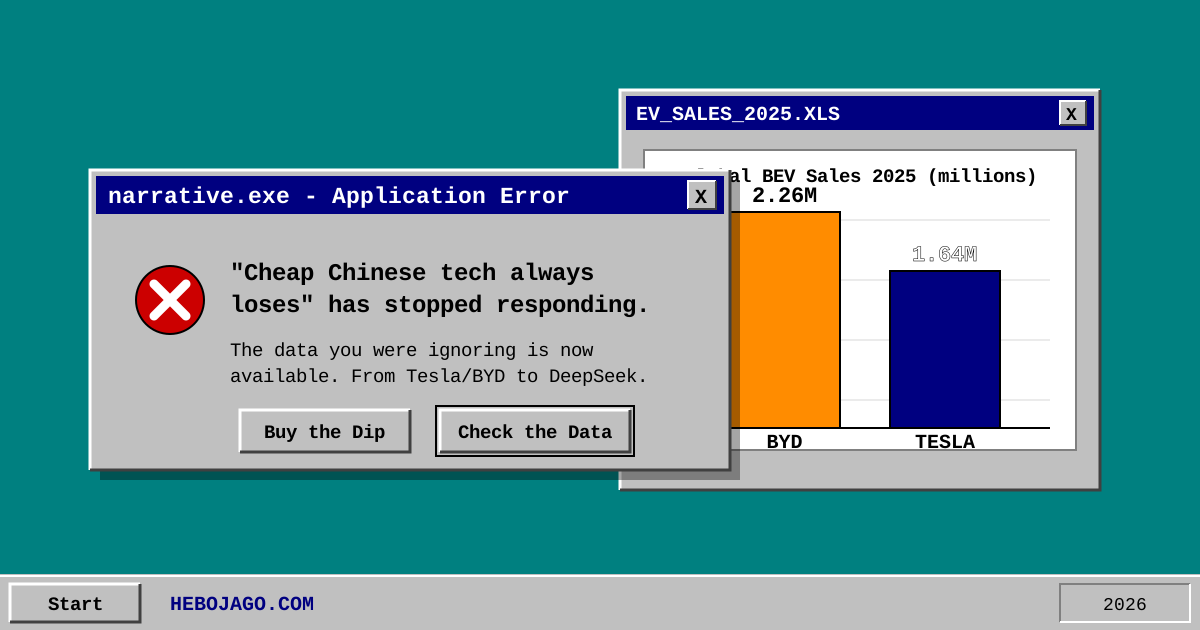
In 2025, BYD sold roughly 2.26 million battery-electric vehicles worldwide, growing about 28% year over year. Tesla delivered about 1.64 million, a decline of roughly 9–10% from 2024 — its second consecutive annual sales drop. That made 2025 the first full calendar year in well over a decade that any automaker outsold Tesla in pure EVs, and BYD didn’t squeak past — it won by more than 600,000 cars.
And it wasn’t just a China story. BYD has been expanding aggressively into Europe and Latin America, often with local production. In Europe, BYD now offers more models than Tesla does. The “quality gap” that Elon Musk once literally laughed about in an interview? It closed. Reviewers stopped treating BYD as a punchline years ago.
So why does the “Tesla won” narrative persist, especially among American investors? Two reasons, and both of them matter enormously for the AI analogy:
1. The tariff wall. BYD sells essentially zero passenger vehicles in the United States. Tesla remains the US EV leader not because American consumers compared the two and chose Tesla — they never got the choice. Trade policy built a wall, and inside that wall, Tesla still looks dominant.
2. The stock changed its story. TSLA shares did crater in early 2024 when BYD first outsold Tesla in a quarter, and the stock did recover. But look at why it recovered. It wasn’t because Tesla clawed back EV market share — deliveries kept falling. The stock recovered because the narrative shifted from “car company” to “AI company”: robotaxis, full self-driving, Optimus. As someone who sells cash-secured puts on TSLA, I watch this stock closely, and I can tell you it has traded on the autonomy story, not delivery numbers, for a long time now.
In other words: the incumbent’s stock survived, but not by winning the fight everyone was watching. It survived by changing the subject — while the cheap challenger quietly took the global volume crown.
That is the real BYD lesson. And it should make US AI investors a lot less comfortable than the fairy-tale version.
Now apply it honestly to DeepSeek
The parallel everyone wants to draw: DeepSeek is cheaper per token, but it’s “not even close” to OpenAI’s or Anthropic’s frontier models, so users will eventually come back to US-made AI, just like car buyers “came back” to Tesla.
But we just established that car buyers didn’t come back to Tesla. Globally, they left. So if you apply the analogy honestly, DeepSeek isn’t the fad in this story — DeepSeek is BYD. The cheap challenger whose quality gap keeps narrowing while the incumbents’ costs stay high.
And here’s where the analogy gets genuinely scary for the “US AI wins by default” crowd: there is no tariff wall for software.
BYD is locked out of the US market by trade policy. A physical car has to clear customs. An open-weights AI model doesn’t. DeepSeek publishes its model weights openly, which means Microsoft can download them, fine-tune them, and run them entirely on Azure servers in the United States — no data flowing to China, no licensing payment to a Chinese company, no business relationship at all. That’s exactly what Microsoft says it would do: an optional, self-hosted, fine-tuned DeepSeek V4 living inside Azure’s security and compliance boundary.
The one wall that does exist is political. Washington has floated banning DeepSeek outright, several governments have already banned it from official networks, and Microsoft naming a Chinese model as a candidate for its flagship enterprise product drew immediate criticism. Politics may yet do for US AI labs what tariffs did for Tesla’s home market. But that’s a policy moat, not a product moat — and policy moats can be redrawn with one election or one executive order.
Where the US labs actually win (and it’s not patriotism)
So is the bear case complete? Should we assume DeepSeek does to OpenAI and Anthropic what BYD did to Tesla?
Not quite — and this is where the analogy finally breaks in a useful direction.
Notice what Microsoft is actually doing. It isn’t replacing its frontier models with DeepSeek. Copilot Cowork today runs on Anthropic and OpenAI models, and Microsoft is evaluating DeepSeek (or another open-source model) specifically as the lower-cost tier under usage-based pricing. The premium, high-stakes agentic work stays on the frontier models. The cheap, high-volume routine work goes to whatever is cheapest.
That’s not a story about one side winning. That’s a story about the market bifurcating:
- Commodity inference — summarization, routine drafting, simple agent steps — races to the bottom on price. Open-source models, including Chinese ones, dominate here because you can’t beat “nearly free and self-hostable.”
- Frontier capability — complex agentic work, code that has to be right, anything touching regulated or sensitive data — stays with the US labs, defended by genuine capability gaps, enterprise trust, compliance requirements, and yes, government pressure.
The auto industry has looked like this forever: Toyota and BYD own volume; Porsche and Ferrari own margin. Nobody thinks Ferrari “lost” to Toyota. The mistake is expecting one winner in a market that’s structurally splitting into two.
What this means for your portfolio
I’m not a financial advisor, and none of this is a recommendation — it’s how I’m framing my own thinking:
Don’t buy the comfortable narrative. “Cheap Chinese AI is junk and everyone will come back to US models” is the same story investors told about BYD, and it aged terribly. Price your theses on data, not flattery.
Watch the bifurcation, not the horse race. The interesting question isn’t “DeepSeek vs. OpenAI.” It’s how much of total AI workload ends up in the commodity tier versus the frontier tier. Frontier labs keeping 20% of tokens but 80% of revenue is a very different world from the reverse — and infrastructure names like Microsoft and Nvidia get paid in both scenarios, which is partly why MSFT can shop for cheaper models without hurting its own story.
Respect the policy wildcard. Tesla’s US “win” was manufactured by tariffs. If Washington bans or restricts Chinese open-source models, US labs get a similar artificial home-field advantage — bullish for them, but fragile, because it can reverse.
Separate the company from the stock. Tesla lost the global EV war and TSLA still recovered, because the stock found a new story. Narratives can carry a stock long after the original thesis dies. That cuts both ways, and it’s exactly why I sell puts on volatility-rich names like TSLA instead of pretending I can predict which narrative wins.
The BYD lesson isn’t “quality always wins.” It’s that cheap-and-good-enough wins the volume war, walls decide who gets protected, and stocks survive by changing the story. Every one of those forces is already visible in the AI market. The investors who’ll get hurt are the ones still telling themselves the fairy-tale version.
Disclosure: I actively trade options (primarily cash-secured puts) on TSLA and NVDA, and may hold positions in securities mentioned. This article is for informational purposes only and is not investment advice. Sources: Axios reporting on Microsoft’s Copilot Cowork pricing and model evaluation (June 2026); Statista and industry delivery trackers for 2025 BYD/Tesla sales figures.
*** THE NUMBERS ***
- BYD global BEV sales, 2025 2.26M (+28%)
- Tesla deliveries, 2025 vs 2024
1.79M1.64M - The gap nobody predicted 600K+ vehicles
Hebojago is for information only and is not investment, tax, or legal advice. Rates and offers change — verify terms with the provider before acting.
*** GUESTBOOK / COMMENTS ***
MORE IN INVESTING
 FIG. 51
Why You're Afraid to Invest in Stocks — and Why My Mom Was Wrong About Losing It All
My mom thought investing could leave you owing money. Here's the math that actually matters — and the risk nobody warns you about.
Most people are scared off investing by the extreme stories the news loves to run. Here's what's actually true about risk, why doing nothing quietly costs you, and how I'd start.
My mom has never bought a single share of stock in her life. And when I asked her why, her answer was basically a highlight reel of the scariest headlines she’d ever seen: people losing everything, people going bankrupt, people who “played the stock market” and ended up worse than broke.
The line that stuck with me most: she genuinely believed you could lose more money than you put in. Like, invest $1,000 and somehow end up owing $3,000.
And here’s the thing — she’s not dumb, and she’s not alone. That fear is incredibly common. It’s just aimed at the wrong target. So let me do what I always try to do here: no hype, just math.
First, the big one: you (almost certainly) can’t lose more than you invest
When you buy a normal share of a stock — or a fund like an S&P 500 ETF — with your own cash, the absolute worst case is that it goes to zero. You lose 100% of what you put in. That’s genuinely bad! But it’s not “you now owe the broker money.” The floor is your investment. Full stop.
What my mom was describing — losing more than you invested — is a real thing, but it’s a different, more dangerous game:
- Margin — borrowing money from your broker to buy more stock than you can afford. Now you can owe.
- Options and futures written the risky way — selling naked calls, that kind of thing.
- Leverage in general — anything where you’re playing with borrowed money.
That’s the world where the horror stories come from. And here’s the honest part: I do trade options (cash-secured puts, mostly) and I’ve held leveraged positions, so I’m not going to pretend that corner of the market doesn’t exist. But that’s the deep end of the pool. Buying VOO with your own money is the shallow end, and the shallow end does not have an “owe money” trap door.
Nobody explained that distinction to my mom. The news definitely didn’t.
The news only shows you the car crashes
Think about how financial media works. “Retiree calmly bought an index fund and it slowly went up over 20 years” is not a headline. It’s not a story. Nobody clicks it.
“Trader loses life savings on meme stock” — that’s a story. So is the bankruptcy, the crypto blowup, the guy who bet everything on options and lost. The extreme cases get 100% of the airtime, which quietly teaches people that the extreme case is investing.
It’s survivorship bias in reverse. You’re only shown the disasters, so you conclude the whole thing is a disaster. Meanwhile the boring, math-y version that actually builds most people’s retirement never makes the screen.
The risk nobody puts on the news: doing nothing
Here’s the part that flips the whole fear on its head.
Everyone treats cash in the bank as the “safe” choice. And in the short term, sure — the number in your account doesn’t drop. But there’s a silent leak: inflation.
As of the last reading, inflation (CPI) was running about 3.5% over the past year. That means the same groceries, gas, and rent cost ~3.5% more than they did a year ago. Your dollar buys less. Every year. Guaranteed.
So the real question isn’t “is investing risky?” It’s “is my money keeping up with inflation, or quietly bleeding buying power?” And for a lot of people, the honest answer is: it’s bleeding.
”But the bank is safe, right?” — yes and no
I want to be fair here, because “the bank” isn’t one thing.
If your money is sitting in a big brick-and-mortar bank’s savings account, you’re probably earning something like 0.01% APY. That is not a typo. On the big national banks, $1,000 parked for a year earns you about a dime. Against 3.5% inflation, that’s a straight-up loss of buying power — you’re paying the bank for the privilege of watching your money shrink.
But — and I’d be a hypocrite not to say this — there’s a better version of “the bank”: a high-yield savings account (HYSA). Right now the best ones pay around 4% APY. That actually beats the current 3.5% inflation. So if you’re sitting on an emergency fund or cash you’ll need soon, moving it from a 0.01% account to a ~4% HYSA is one of the easiest wins in personal finance, and I’d tell anyone to do that first.
So why invest at all, if a HYSA beats inflation today? Two reasons:
- HYSA rates are temporary. They float with the Fed. A few years ago they were near zero, and they’ll come back down. Inflation doesn’t ask permission.
- Beating inflation by a hair isn’t building wealth. It’s treading water. Growing your money — actually multiplying it — is a different job, and that’s the job stocks have historically done.
So what does “investing” actually look like for a normal person?
Not options. Not day-trading. Not the stuff on the news. For most people it’s shockingly boring:
Buy a low-cost fund that owns a slice of the 500 biggest U.S. companies — something like VOO — and just… hold it. When you own VOO, you’re not betting on one company surviving. You own a piece of all of them at once. For that fund to go to zero, all 500 of America’s largest companies would have to be worth nothing simultaneously — at which point, honestly, we’d all have much bigger problems than our brokerage balance.
How’s it done? VOO is up about +8.95% so far in 2026 (through late July, dividends reinvested). That’s comfortably ahead of the 3.5% inflation rate — so this year, holding it protected your buying power and grew it.
Zoom out and the long-run number people usually cite for the S&P 500 is roughly 10% per year on average (nominal). That “average” is doing a lot of work, though, which brings me to the caveats — because there’s always a catch.
The honest downsides (there’s always a catch)
I’m not here to sell you a fantasy. Investing in stocks is genuinely risky, and anyone who tells you otherwise is selling something:
- It does not go up in a straight line. VOO was down about 18% in 2022. If you’d put money in at the start of that year, you’d have watched a chunk of it vanish on paper for months. Even right now, VOO is sitting a couple percent below its high from earlier this summer. Green years and red years are both part of the deal.
- “Average 10%” is not “10% every year.” Some years are +25%, some are −18%. The average only shows up if you stay in through the ugly ones — which is exactly when panic makes people sell.
- Past performance doesn’t guarantee anything. Everything above is history. History rhymes; it doesn’t promise.
- You can absolutely lose money, especially over short windows. The one thing that has historically bailed people out is time — long holding periods have smoothed out most of the rough patches. Money you need next year should not be in stocks.
The point isn’t “stocks are safe.” It’s that there’s a risk on both sides — the visible risk of investing, and the invisible risk of letting cash rot. Well-informed people don’t avoid risk; they pick which risk they’re taking on purpose.
How I’d actually start (small and boring on purpose)
If I were walking my mom into this, it wouldn’t be “put your savings in the market tomorrow.” It’d be:
- Emergency fund first, in a ~4% HYSA. Not invested. Untouchable.
- Then a small, automatic, boring amount into a broad index fund every month — an amount that wouldn’t ruin your week if it dropped 20%.
- Don’t watch it daily. Daily watching is how you turn a 30-year plan into a 30-day panic.
Related reading on Hebojago: (https://hebojago.com/post/stay-calm-market-crash/).
Let’s make $millions$ (the unsexy way)
Okay, the fun part. Here’s why I get genuinely excited about this instead of scared:
Put $500 a month into a broad index fund and let it compound at that long-run ~10% average, and after 30 years you’d have somewhere around $1 million. (Illustrative — it assumes a steady historical average that real markets will never actually deliver in a straight line. Reality will be lumpier. But the ballpark is real.)
That’s not a lottery ticket. It’s not a hot stock tip. It’s boring money, added consistently, left alone, doing the one thing cash in a near-zero account can never do: outrunning inflation and multiplying.
My mom spent decades believing investing was the risky choice. The quiet truth is that not investing — letting inflation nibble her savings year after year — was its own kind of risk the whole time. Nobody put that on the news.
So consider this your invitation. Learn the difference between the shallow end and the deep end. Start small. Stay boring. Let’s go make some $millions$ — slowly, on purpose, with the math on our side.
Not financial advice — I’m a software developer who invests and trades on the side, not a licensed advisor, and this is my experience and my math, not a recommendation for your situation. Returns, inflation, and savings rates cited here (VOO +8.95% YTD, CPI 3.5%, ~4% HYSA, ~0.01% big-bank savings) were accurate as of late July 2026 and change constantly — verify current numbers before you act on them. All future/compounding figures are illustrative; past performance doesn’t guarantee future results, and you can lose money investing.
Hebojago is my journey to financial freedom, recorded live — real experiments, real numbers, wins and mistakes. Follow along here.
- Big-bank savings (Chase/BofA-type) ~0.01% APY
- Best high-yield savings account ~4.00% APY
- Inflation (CPI, 12 mo. thru June 2026) 3.5%
- VOO (S&P 500 ETF), YTD 2026 +8.95%
 FIG. 86
Can You Borrow Against Stocks to Buy a House? I Sold Instead — Here's What It Cost Me
In 2023 I liquidated almost my entire portfolio for a down payment. Then I learned about the tool the wealthy use — and why it wouldn't have worked for me anyway.
You can borrow against a brokerage account instead of selling it — it's called a securities-backed line of credit. Here's the real math, the minimums nobody mentions, and why my own mistake cost me market exposure, not taxes.
In 2023 my wife and I bought the house we live in now. To get to the down payment, I sold almost every single stock in my portfolio — around $50,000 worth. Basically all of it.
I didn’t know securities-backed lines of credit existed at the time. If I had, I don’t think I would have sold a share. That $50,000 would be more than $100,000 today by my rough math.
That’s the confession. Now here’s the part that took me longer to admit: even if I’d known, it wouldn’t have worked. Not at my size. And figuring out why taught me more than the original regret did.
The thing rich people do instead of selling
The pitch you’ve probably seen on social media goes like this. You have $1 million in stock. You want a $1 million house. Everyone else sells $200,000 to cover the 20% down and eats a tax bill. The wealthy don’t sell — they borrow against the portfolio instead, walk into closing owing nothing to the IRS, and leave the whole $1 million compounding.
The tool is real and it has a boring name: a securities-backed line of credit, or SBLOC. Depending on the brokerage you’ll also see it called a pledged asset line or a liquidity access line. Same idea.
Here’s how it actually works. You pledge the stocks, ETFs, and bonds in a taxable brokerage account as collateral. The lender opens a revolving credit line against them. Advance rates typically run 50% to 75% on a diversified equity portfolio — so a $1 million account might support $500,000 to $750,000 of borrowing power. You draw what you need, you pay interest only on what you’ve drawn, and there’s usually no fixed repayment schedule.
One hard rule: the money can be used for almost anything except buying more securities. Real estate is a normal, allowed use. Fidelity’s own materials list buying or renovating real estate right alongside a wedding, tuition, or a tax bill.
So the mechanism is legitimate. It’s the math around it that gets oversold.
The illustrative math, done honestly
Let me run that $1 million example properly. These are illustrative numbers, not mine — I’ll get to my real ones below.
If you sell $200,000 of stock: you owe tax on the gain, not the sale amount. That distinction gets mangled constantly. If your cost basis is 50%, the gain is $100,000, and federal long-term capital gains tax at 15% is about $15,000 — maybe $19,000 once the 3.8% net investment income tax kicks in. Not the $40,000 you’ll see quoted, which quietly assumes a zero cost basis and the top rate.
If you’re in Washington, it’s even less. The state levies 7% on long-term gains above a standard deduction of $278,000 for 2025 — indexed annually, with the 2026 figure not yet published. A $100,000 gain doesn’t come close. Washington charges you nothing.
If you borrow $200,000 instead: SBLOC rates in May 2026 ran roughly 5.80% to 7.95% across major brokers — SOFR around 4.30% plus a spread of 1.50% to 3.65% depending on balance and lender. Call it 6.5%. That’s $13,000 a year in interest.
Now the comparison people get wrong. Selling leaves you $800,000 compounding instead of $1 million. The difference isn’t growth on the whole million — it’s growth on the $200,000 you didn’t sell. At 10%, that’s $20,000 a year.
$20,000 of extra growth, minus $13,000 of interest, is about $7,000 a year of edge. Real. Worth understanding. But it’s a spread trade, not free money — and it only works while your portfolio out-earns your loan.
Three things the hype posts leave out
You didn’t skip the tax. You deferred it. Sell later to pay down the line and the IRS is still standing there. The only version where the tax genuinely disappears is the one where you die holding the shares and your heirs get a stepped-up basis. That’s the actual engine behind “buy, borrow, die,” and it’s worth saying out loud instead of implying the bill evaporates.
The interest isn’t deductible. Borrow against stocks to buy a personal residence and it’s not investment interest, because the proceeds didn’t go into investments. It’s not mortgage interest either, because the loan isn’t secured by the house. So 6.5% is a full 6.5%, with no tax shield underneath it.
The rate floats. Every major SBLOC product is floating-rate and resets monthly with SOFR, so a Fed move flows through within 30 to 45 days. Whatever rate you sign at is a snapshot, not a term.
The risk that ends the party
The single biggest risk is the maintenance call: if your portfolio falls below the lender’s threshold, you deposit cash or accept forced liquidation.
Read that again, because it’s the whole ballgame. In a bad enough drawdown, the broker sells your positions — at the bottom, on their schedule, not yours. It’s the exact scenario every long-term investor spends their life trying to avoid, except now it isn’t your choice.
Borrowing $200,000 against $1 million is only 20% loan-to-value, which is genuinely conservative — you’d need a catastrophic decline to get called. But notice what you’ve built: an 80% mortgage on the house, a callable loan covering the other 20%, and zero equity cushion anywhere. You are 100% levered on the property while carrying a demand loan on top. In a good decade that’s brilliant. In 2008 it’s a story people tell about you.
And not everything qualifies as collateral — illiquid or volatile holdings may be excluded outright, which limits how much you can actually borrow.
The part almost nobody mentions: your mortgage lender
This one surprised me. Using borrowed money for a down payment is allowed — Fannie Mae’s guideline B3-4.3-15 says borrowed funds secured by an asset are an acceptable source for down payment, closing costs, and reserves, and financial assets like stocks and bonds count as qualifying collateral.
But there’s a price. The lender must count the monthly payment on that secured loan as debt when qualifying you. And if you’re also counting that same portfolio as reserves, its value gets reduced by the amount you borrowed against it.
Translation: the SBLOC shrinks how much house you qualify for. You solved the down payment and made the approval harder in the same move. Run your numbers through the mortgage calculator both ways before you assume this is free.
So why wouldn’t it have worked for me?
Here’s where my regret ran into arithmetic.
Minimum portfolio sizes for an SBLOC run $100,000 to $250,000. Schwab, for instance, may require you to pledge a minimum dollar amount — $100,000 is a typical figure. My whole taxable portfolio in 2023 was around $50,000.
Even in a fantasy where someone took me as a client, a 50-75% advance rate on $50,000 is $25,000 to $35,000 of credit. That doesn’t cover a down payment in the Seattle area. It doesn’t come close.
And the rate would have been ugly. SOFR hit an all-time high of 5.40% in December 2023. Add a typical 2-3% spread and I’d have been borrowing at 7.5% to 8.5% — against a portfolio I was hoping would outrun it.
So the honest version of my mistake isn’t “I didn’t know about SBLOCs.” It’s this: I was below the threshold where the sophisticated option even becomes available. The tool exists at $250,000. It doesn’t exist at $50,000. That’s not a secret being kept from regular people so much as a floor most of us haven’t crossed yet.
What it actually cost me — and it wasn’t the tax
Everyone writing about this sells the tax angle. At my size, the tax angle was almost irrelevant. Washington charged me nothing. Federal tax on whatever portion of that $50,000 was gain was a small number.
What cost me was three years out of the market. That $50,000 would be north of $100,000 today by my estimate. The expensive thing wasn’t a tax bill — it was selling my compounding to buy a roof.
That’s the lesson I’d actually hand someone: when you’re deciding whether to liquidate for a house, run the opportunity cost, not the tax cost. The tax is a one-time bill you can size in an afternoon. The forgone growth is the one that keeps charging you.
Would I do it differently now?
Yes — with conditions.
If I needed money today for a house or something similarly large, I’d borrow against my stocks rather than sell them, as long as I expect the return to beat the interest. That’s the test. Not “debt is bad,” not “never sell,” just: does the money I keep invested earn more than the money I’m renting?
But I have to name the thing that makes me a bad candidate for my own advice. My portfolio is over half NVDA, plus a 3x leveraged semiconductor ETF. That’s not the diversified collateral base those 50-75% advance rates assume. A lender would haircut me hard, and the leveraged fund likely wouldn’t count as collateral at all. Worse, the drawdown that triggers a maintenance call in a concentrated semiconductor portfolio is exactly the drawdown that hits everything I own at once — the collateral and the conviction fail on the same day.
So I’ll say the useful version rather than the flattering one: an SBLOC is a diversified-portfolio tool, and I don’t have a diversified portfolio. If I want to use one properly, the fix isn’t a better broker. It’s fixing my concentration first.
Right now every dollar of debt I carry is on the house. I’m not in a rush to change that until the collateral underneath a line of credit is something I’d trust in a bad quarter.
The honest summary
- Borrowing against stock instead of selling is a real, legal, unremarkable tool. It’s not a loophole.
- It defers tax, it doesn’t erase it — the erasure only happens at death via stepped-up basis.
- The interest isn’t deductible for a home purchase, and the rate floats with SOFR.
- The maintenance call is the risk that matters, and concentrated portfolios are the worst candidates.
- Your mortgage lender counts the payment against you and discounts your reserves.
- And there’s a minimum. Below roughly $100,000 in a taxable account, this isn’t a decision you get to make.
If you’re under that threshold and staring at a down payment, don’t let a social media post convince you that you’re missing a secret. You’re not. You’re just early. Keep compounding, and revisit this when the portfolio is big enough that the question is real.
Not financial advice — this is my own experience and my own math, and I got the original decision wrong. SBLOC rates, minimums, and advance rates vary by brokerage and change constantly; the figures here reflect published rates as of mid-2026 and should be verified directly with your broker before you commit to anything. Washington’s capital gains standard deduction is the 2025 amount, indexed annually, and the 2026 figure had not been published at the time of writing. Borrowing against a concentrated portfolio carries forced-liquidation risk that no interest rate comparison captures. Talk to a CPA about your own tax situation before making a decision of this size.
- Stock I sold in 2023 ~$50,000
- What it'd be worth now (my estimate)
$50,000$100,000+ - Typical SBLOC minimum portfolio $100,000–$250,000
- Typical SBLOC rate, mid-2026 5.80%–7.95%