The Chipotle Playbook: What a Produce Outbreak Actually Does to Stocks (and What It Doesn't)
A 34-state parasite outbreak, and a lesson in reading catalysts
A cyclosporiasis outbreak has hit thousands across 34+ states, and investors are already asking which restaurant stocks get hit and which diagnostic stocks pop. The honest answer separates a real catalyst from a headline — and points to a watchlist worth keeping.
There’s a parasite in the salad, and Wall Street is trying to figure out what to do about it.
As of mid-July 2026, the CDC has confirmed 1,645 domestic cases of cyclosporiasis across more than 34 states, with over 5,100 additional probable cases still being sorted out — some tallies put the combined figure near 7,000. That is a staggering jump from just 249 cases nationally by this same point last year. Michigan alone accounts for more than half the confirmed cases, and investigators have flagged lettuce and salad greens as a likely culprit, though no single source has been confirmed.
Cyclosporiasis is nasty but rarely dangerous — think prolonged, “explosive” watery diarrhea, fatigue, and weight loss, treatable with a course of antibiotics. There have been 141 hospitalizations and no deaths. So this isn’t a public-health catastrophe. But it is a market event, and the way investors are reacting to it is a perfect case study in one of the most useful skills you can develop: telling a real catalyst from a headline.
Let me walk through what an outbreak like this actually does to stocks, who’s exposed, and — because this is Hebojago — how I’d actually think about playing it.
The one time this really mattered: the Chipotle template
If you want to know what a produce-borne outbreak can do to a stock, you don’t have to theorize. Chipotle already ran the experiment for us, and the results were brutal.
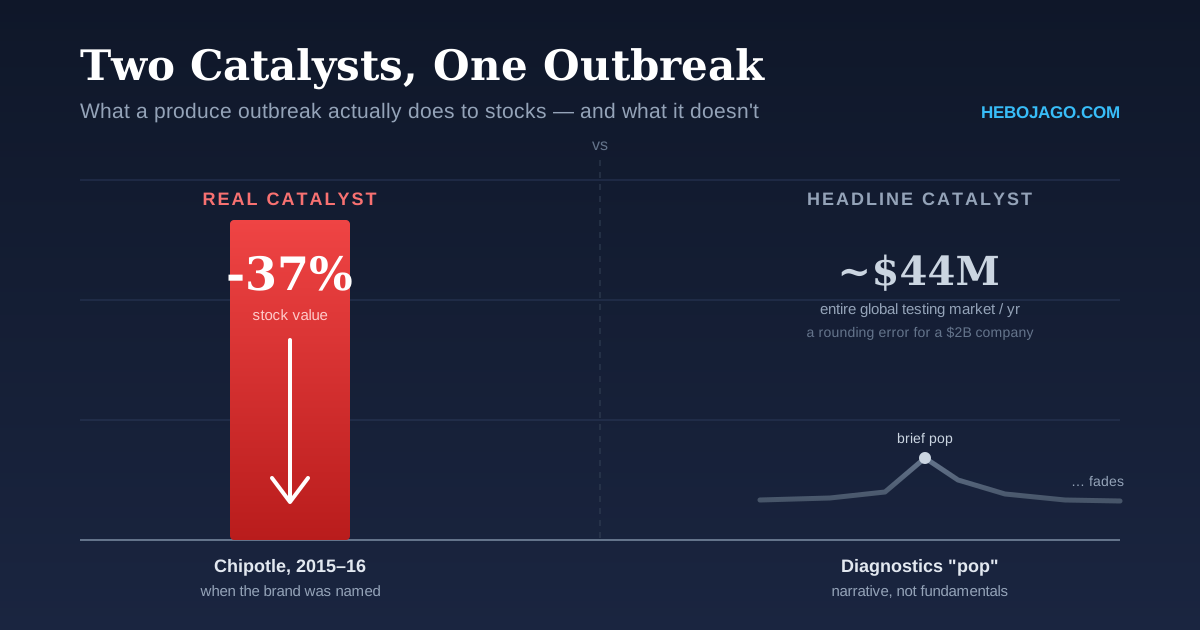
In late 2015, the CDC linked an E. coli outbreak directly to Chipotle restaurants across multiple states. The stock, which had traded around $757 in October 2015, cratered to roughly $475 by February 2016 — a decline of about 37% that erased something like $8 billion in market value. This wasn’t a one-day scare that bounced back. Same-store sales fell about 14.6% in the fourth quarter of 2015, the company posted its first sales decline since going public, and it took years to fully rebuild the brand and the multiple.
That’s the template. And it tells you exactly what the market punishes: not the existence of an outbreak, but the naming of a specific brand as the source. The moment the CDC ties cases to your restaurants, three things happen at once — customers stay home (real revenue hit), analysts slash guidance (real estimate cuts), and the “healthy, fresh food” brand premium evaporates (multiple compression). All three fed the Chipotle collapse.
Why the 2026 outbreak is different (so far)
Here’s the part most hot-take articles are getting wrong, and it’s the whole ballgame: no restaurant chain has been named in the 2026 outbreak.
Investigators are pointing at lettuce and leafy greens as a category. That’s very different from pointing at a company. Contaminated produce enters the food supply through distributors and ends up everywhere — grocery stores, cafeterias, and yes, restaurants — but without a named brand at the center, there’s no single stock for the market to punish the way it punished Chipotle.
So the honest framing isn’t “these stocks are going to crash.” It’s: “Here is the template for what happens IF a chain gets named — and here is who is most exposed if that shoe drops.” That’s a watchlist, not a prediction. Anyone selling you a confident forecast right now is guessing.
The watchlist: who’s actually exposed
Exposure here is a function of one thing — how central raw, uncooked produce (especially leafy greens) is to the business. The more a brand’s core product is a bowl of raw greens, the more a lettuce-linked outbreak threatens both its sales and its brand story.
Sweetgreen (SG) — highest structural exposure. This is the name to watch most closely, and it’s the most interesting one on the board. Sweetgreen’s entire identity is raw leafy greens. If the confirmed source turns out to be lettuce, no chain is more thematically and operationally in the blast radius. Its “clean, healthy, fresh” positioning is exactly the kind of brand premium that an outbreak vaporizes — the same premium that made Chipotle’s fall so steep.
Chipotle (CMG) — the veteran with scar tissue. Chipotle uses enormous volumes of produce, including lettuce, so it’s exposed. But it’s also the one chain that has already been through this, spent an estimated $25 million overhauling food safety, and rebuilt investor trust. That cuts both ways: it has the playbook and the systems, but the market also has a memory, and CMG could get hit hard on sentiment alone if it’s ever named again.
Yum! Brands (YUM) — diluted by design. This is a correction worth making, because a lot of people talk about “Taco Bell stock” — there’s no such thing. Taco Bell is owned by Yum! Brands, alongside KFC and Pizza Hut. So even though Taco Bell serves lettuce, any single-brand outbreak exposure is heavily diluted across a three-chain, globally diversified parent. YUM is far more insulated than a pure-play like SG or CMG.
The pattern: pure-plays get punished, diversified parents absorb the blow. That’s a durable lesson well beyond this one outbreak.
The headline catalyst: why the “diagnostics pop” is mostly a mirage
Now the other half of what investors are chatting about: if produce companies are the losers, aren’t the testing companies the winners? Buy the diagnostics names — Qiagen, bioMérieux, and so on?
This is where you need to separate a real catalyst from a headline catalyst, and it’s the most valuable takeaway in this whole piece.
Qiagen (QGEN) did put out a press release this week highlighting that its QIAstat-Dx Gastrointestinal Panel 2 includes Cyclospora as one of its 16 targets, with results in about an hour. Real product, real relevance, genuinely useful in an outbreak. So the narrative connection is airtight — and that’s exactly what makes it a trap.
Look at the actual numbers. The entire global cyclospora diagnostic testing market is estimated at roughly $44 million per year. Qiagen is a company with around $2 billion in annual revenue. Even if this outbreak doubled or tripled cyclospora-specific testing demand overnight, the revenue impact would be a rounding error against Qiagen’s P&L — invisible in an earnings report. A press release timed to an outbreak is a marketing move, not a revenue event.
So what is the diagnostics reaction? It’s sentiment. Traders may bid QGEN or a peer up on headline flow and association, but there’s no fundamental earnings catalyst underneath. That kind of move is fast, thin, and prone to fading once the news cycle moves on — the textbook profile of a headline catalyst.
How to tell them apart, as a rule you can reuse:
A real catalyst changes a company’s future cash flows in a way that will show up in an earnings report — Chipotle losing 15% of same-store sales is real. A headline catalyst changes a company’s association with a news story without meaningfully changing its cash flows — Qiagen being “a cyclospora testing company” for a week is a headline. Real catalysts are worth positioning around. Headline catalysts are mostly worth watching other people get burned by.
How I’d actually think about playing it
None of this is a recommendation — it’s how I frame my own thinking, and I trade options for a living, so I look at these events through a specific lens.
The asymmetry is the thesis. Outbreaks destroy far more value than they create. The downside on a named restaurant stock is large and concrete (Chipotle: -37%). The “upside” on diagnostics is mostly narrative and fades. If you’re hunting for an outbreak trade, respect that the real, sizeable move is on the loser side, not the winner side.
Watch implied volatility, not just price. When an outbreak headline hits a name like SG or CMG, implied volatility on its options tends to spike as fear gets priced in. For someone who sells cash-secured puts, that IV spike is where it gets interesting — but only on a stock you’d genuinely be happy to own through a recovery. The Chipotle lesson is that the fundamentals-strong, brand-strong names eventually came back; CMG went on to fully recover and then some. Selling a put into an inflated-fear moment on a quality name you want to own is a very different act from gambling on a diagnostics pop.
Don’t chase the mirage. If your instinct was “buy QGEN on the outbreak,” this article’s whole job was to talk you out of it. The narrative is real; the materiality isn’t.
Wait for the name. The single biggest swing factor is whether the CDC ends up linking cases to a specific chain. Until then, this is a watchlist. If a name drops, that’s when the Chipotle playbook actually activates — and you’ll already know what to look for.
The market doesn’t reward being early to a headline. It rewards understanding which headlines change cash flows and which just change the conversation. A parasite in the lettuce is a genuinely useful reminder of the difference.
Disclosure: I actively trade options (primarily cash-secured puts) on names including NVDA and TSLA, and may hold or initiate positions in securities mentioned. This article is for informational and educational purposes only and is not investment advice. Sources: CDC cyclosporiasis surveillance (July 2026); Qiagen company press release (July 2026); CNN Money, Forbes, and CNBC reporting on Chipotle’s 2015–2016 E. coli crisis; Future Market Report / Reports and Data cyclospora diagnostic market estimates.
*** THE NUMBERS ***
- Confirmed US cases since May 1
2491,645 - Chipotle stock, Oct 2015 to Feb 2016 -37%
- Global cyclospora testing market ~$44M/yr
Hebojago is for information only and is not investment, tax, or legal advice. Rates and offers change — verify terms with the provider before acting.
*** GUESTBOOK / COMMENTS ***
MORE IN INVESTING
 FIG. 51
Why You're Afraid to Invest in Stocks — and Why My Mom Was Wrong About Losing It All
My mom thought investing could leave you owing money. Here's the math that actually matters — and the risk nobody warns you about.
Most people are scared off investing by the extreme stories the news loves to run. Here's what's actually true about risk, why doing nothing quietly costs you, and how I'd start.
My mom has never bought a single share of stock in her life. And when I asked her why, her answer was basically a highlight reel of the scariest headlines she’d ever seen: people losing everything, people going bankrupt, people who “played the stock market” and ended up worse than broke.
The line that stuck with me most: she genuinely believed you could lose more money than you put in. Like, invest $1,000 and somehow end up owing $3,000.
And here’s the thing — she’s not dumb, and she’s not alone. That fear is incredibly common. It’s just aimed at the wrong target. So let me do what I always try to do here: no hype, just math.
First, the big one: you (almost certainly) can’t lose more than you invest
When you buy a normal share of a stock — or a fund like an S&P 500 ETF — with your own cash, the absolute worst case is that it goes to zero. You lose 100% of what you put in. That’s genuinely bad! But it’s not “you now owe the broker money.” The floor is your investment. Full stop.
What my mom was describing — losing more than you invested — is a real thing, but it’s a different, more dangerous game:
- Margin — borrowing money from your broker to buy more stock than you can afford. Now you can owe.
- Options and futures written the risky way — selling naked calls, that kind of thing.
- Leverage in general — anything where you’re playing with borrowed money.
That’s the world where the horror stories come from. And here’s the honest part: I do trade options (cash-secured puts, mostly) and I’ve held leveraged positions, so I’m not going to pretend that corner of the market doesn’t exist. But that’s the deep end of the pool. Buying VOO with your own money is the shallow end, and the shallow end does not have an “owe money” trap door.
Nobody explained that distinction to my mom. The news definitely didn’t.
The news only shows you the car crashes
Think about how financial media works. “Retiree calmly bought an index fund and it slowly went up over 20 years” is not a headline. It’s not a story. Nobody clicks it.
“Trader loses life savings on meme stock” — that’s a story. So is the bankruptcy, the crypto blowup, the guy who bet everything on options and lost. The extreme cases get 100% of the airtime, which quietly teaches people that the extreme case is investing.
It’s survivorship bias in reverse. You’re only shown the disasters, so you conclude the whole thing is a disaster. Meanwhile the boring, math-y version that actually builds most people’s retirement never makes the screen.
The risk nobody puts on the news: doing nothing
Here’s the part that flips the whole fear on its head.
Everyone treats cash in the bank as the “safe” choice. And in the short term, sure — the number in your account doesn’t drop. But there’s a silent leak: inflation.
As of the last reading, inflation (CPI) was running about 3.5% over the past year. That means the same groceries, gas, and rent cost ~3.5% more than they did a year ago. Your dollar buys less. Every year. Guaranteed.
So the real question isn’t “is investing risky?” It’s “is my money keeping up with inflation, or quietly bleeding buying power?” And for a lot of people, the honest answer is: it’s bleeding.
”But the bank is safe, right?” — yes and no
I want to be fair here, because “the bank” isn’t one thing.
If your money is sitting in a big brick-and-mortar bank’s savings account, you’re probably earning something like 0.01% APY. That is not a typo. On the big national banks, $1,000 parked for a year earns you about a dime. Against 3.5% inflation, that’s a straight-up loss of buying power — you’re paying the bank for the privilege of watching your money shrink.
But — and I’d be a hypocrite not to say this — there’s a better version of “the bank”: a high-yield savings account (HYSA). Right now the best ones pay around 4% APY. That actually beats the current 3.5% inflation. So if you’re sitting on an emergency fund or cash you’ll need soon, moving it from a 0.01% account to a ~4% HYSA is one of the easiest wins in personal finance, and I’d tell anyone to do that first.
So why invest at all, if a HYSA beats inflation today? Two reasons:
- HYSA rates are temporary. They float with the Fed. A few years ago they were near zero, and they’ll come back down. Inflation doesn’t ask permission.
- Beating inflation by a hair isn’t building wealth. It’s treading water. Growing your money — actually multiplying it — is a different job, and that’s the job stocks have historically done.
So what does “investing” actually look like for a normal person?
Not options. Not day-trading. Not the stuff on the news. For most people it’s shockingly boring:
Buy a low-cost fund that owns a slice of the 500 biggest U.S. companies — something like VOO — and just… hold it. When you own VOO, you’re not betting on one company surviving. You own a piece of all of them at once. For that fund to go to zero, all 500 of America’s largest companies would have to be worth nothing simultaneously — at which point, honestly, we’d all have much bigger problems than our brokerage balance.
How’s it done? VOO is up about +8.95% so far in 2026 (through late July, dividends reinvested). That’s comfortably ahead of the 3.5% inflation rate — so this year, holding it protected your buying power and grew it.
Zoom out and the long-run number people usually cite for the S&P 500 is roughly 10% per year on average (nominal). That “average” is doing a lot of work, though, which brings me to the caveats — because there’s always a catch.
The honest downsides (there’s always a catch)
I’m not here to sell you a fantasy. Investing in stocks is genuinely risky, and anyone who tells you otherwise is selling something:
- It does not go up in a straight line. VOO was down about 18% in 2022. If you’d put money in at the start of that year, you’d have watched a chunk of it vanish on paper for months. Even right now, VOO is sitting a couple percent below its high from earlier this summer. Green years and red years are both part of the deal.
- “Average 10%” is not “10% every year.” Some years are +25%, some are −18%. The average only shows up if you stay in through the ugly ones — which is exactly when panic makes people sell.
- Past performance doesn’t guarantee anything. Everything above is history. History rhymes; it doesn’t promise.
- You can absolutely lose money, especially over short windows. The one thing that has historically bailed people out is time — long holding periods have smoothed out most of the rough patches. Money you need next year should not be in stocks.
The point isn’t “stocks are safe.” It’s that there’s a risk on both sides — the visible risk of investing, and the invisible risk of letting cash rot. Well-informed people don’t avoid risk; they pick which risk they’re taking on purpose.
How I’d actually start (small and boring on purpose)
If I were walking my mom into this, it wouldn’t be “put your savings in the market tomorrow.” It’d be:
- Emergency fund first, in a ~4% HYSA. Not invested. Untouchable.
- Then a small, automatic, boring amount into a broad index fund every month — an amount that wouldn’t ruin your week if it dropped 20%.
- Don’t watch it daily. Daily watching is how you turn a 30-year plan into a 30-day panic.
Related reading on Hebojago: (https://hebojago.com/post/stay-calm-market-crash/).
Let’s make $millions$ (the unsexy way)
Okay, the fun part. Here’s why I get genuinely excited about this instead of scared:
Put $500 a month into a broad index fund and let it compound at that long-run ~10% average, and after 30 years you’d have somewhere around $1 million. (Illustrative — it assumes a steady historical average that real markets will never actually deliver in a straight line. Reality will be lumpier. But the ballpark is real.)
That’s not a lottery ticket. It’s not a hot stock tip. It’s boring money, added consistently, left alone, doing the one thing cash in a near-zero account can never do: outrunning inflation and multiplying.
My mom spent decades believing investing was the risky choice. The quiet truth is that not investing — letting inflation nibble her savings year after year — was its own kind of risk the whole time. Nobody put that on the news.
So consider this your invitation. Learn the difference between the shallow end and the deep end. Start small. Stay boring. Let’s go make some $millions$ — slowly, on purpose, with the math on our side.
Not financial advice — I’m a software developer who invests and trades on the side, not a licensed advisor, and this is my experience and my math, not a recommendation for your situation. Returns, inflation, and savings rates cited here (VOO +8.95% YTD, CPI 3.5%, ~4% HYSA, ~0.01% big-bank savings) were accurate as of late July 2026 and change constantly — verify current numbers before you act on them. All future/compounding figures are illustrative; past performance doesn’t guarantee future results, and you can lose money investing.
Hebojago is my journey to financial freedom, recorded live — real experiments, real numbers, wins and mistakes. Follow along here.
- Big-bank savings (Chase/BofA-type) ~0.01% APY
- Best high-yield savings account ~4.00% APY
- Inflation (CPI, 12 mo. thru June 2026) 3.5%
- VOO (S&P 500 ETF), YTD 2026 +8.95%
 FIG. 86
Can You Borrow Against Stocks to Buy a House? I Sold Instead — Here's What It Cost Me
In 2023 I liquidated almost my entire portfolio for a down payment. Then I learned about the tool the wealthy use — and why it wouldn't have worked for me anyway.
You can borrow against a brokerage account instead of selling it — it's called a securities-backed line of credit. Here's the real math, the minimums nobody mentions, and why my own mistake cost me market exposure, not taxes.
In 2023 my wife and I bought the house we live in now. To get to the down payment, I sold almost every single stock in my portfolio — around $50,000 worth. Basically all of it.
I didn’t know securities-backed lines of credit existed at the time. If I had, I don’t think I would have sold a share. That $50,000 would be more than $100,000 today by my rough math.
That’s the confession. Now here’s the part that took me longer to admit: even if I’d known, it wouldn’t have worked. Not at my size. And figuring out why taught me more than the original regret did.
The thing rich people do instead of selling
The pitch you’ve probably seen on social media goes like this. You have $1 million in stock. You want a $1 million house. Everyone else sells $200,000 to cover the 20% down and eats a tax bill. The wealthy don’t sell — they borrow against the portfolio instead, walk into closing owing nothing to the IRS, and leave the whole $1 million compounding.
The tool is real and it has a boring name: a securities-backed line of credit, or SBLOC. Depending on the brokerage you’ll also see it called a pledged asset line or a liquidity access line. Same idea.
Here’s how it actually works. You pledge the stocks, ETFs, and bonds in a taxable brokerage account as collateral. The lender opens a revolving credit line against them. Advance rates typically run 50% to 75% on a diversified equity portfolio — so a $1 million account might support $500,000 to $750,000 of borrowing power. You draw what you need, you pay interest only on what you’ve drawn, and there’s usually no fixed repayment schedule.
One hard rule: the money can be used for almost anything except buying more securities. Real estate is a normal, allowed use. Fidelity’s own materials list buying or renovating real estate right alongside a wedding, tuition, or a tax bill.
So the mechanism is legitimate. It’s the math around it that gets oversold.
The illustrative math, done honestly
Let me run that $1 million example properly. These are illustrative numbers, not mine — I’ll get to my real ones below.
If you sell $200,000 of stock: you owe tax on the gain, not the sale amount. That distinction gets mangled constantly. If your cost basis is 50%, the gain is $100,000, and federal long-term capital gains tax at 15% is about $15,000 — maybe $19,000 once the 3.8% net investment income tax kicks in. Not the $40,000 you’ll see quoted, which quietly assumes a zero cost basis and the top rate.
If you’re in Washington, it’s even less. The state levies 7% on long-term gains above a standard deduction of $278,000 for 2025 — indexed annually, with the 2026 figure not yet published. A $100,000 gain doesn’t come close. Washington charges you nothing.
If you borrow $200,000 instead: SBLOC rates in May 2026 ran roughly 5.80% to 7.95% across major brokers — SOFR around 4.30% plus a spread of 1.50% to 3.65% depending on balance and lender. Call it 6.5%. That’s $13,000 a year in interest.
Now the comparison people get wrong. Selling leaves you $800,000 compounding instead of $1 million. The difference isn’t growth on the whole million — it’s growth on the $200,000 you didn’t sell. At 10%, that’s $20,000 a year.
$20,000 of extra growth, minus $13,000 of interest, is about $7,000 a year of edge. Real. Worth understanding. But it’s a spread trade, not free money — and it only works while your portfolio out-earns your loan.
Three things the hype posts leave out
You didn’t skip the tax. You deferred it. Sell later to pay down the line and the IRS is still standing there. The only version where the tax genuinely disappears is the one where you die holding the shares and your heirs get a stepped-up basis. That’s the actual engine behind “buy, borrow, die,” and it’s worth saying out loud instead of implying the bill evaporates.
The interest isn’t deductible. Borrow against stocks to buy a personal residence and it’s not investment interest, because the proceeds didn’t go into investments. It’s not mortgage interest either, because the loan isn’t secured by the house. So 6.5% is a full 6.5%, with no tax shield underneath it.
The rate floats. Every major SBLOC product is floating-rate and resets monthly with SOFR, so a Fed move flows through within 30 to 45 days. Whatever rate you sign at is a snapshot, not a term.
The risk that ends the party
The single biggest risk is the maintenance call: if your portfolio falls below the lender’s threshold, you deposit cash or accept forced liquidation.
Read that again, because it’s the whole ballgame. In a bad enough drawdown, the broker sells your positions — at the bottom, on their schedule, not yours. It’s the exact scenario every long-term investor spends their life trying to avoid, except now it isn’t your choice.
Borrowing $200,000 against $1 million is only 20% loan-to-value, which is genuinely conservative — you’d need a catastrophic decline to get called. But notice what you’ve built: an 80% mortgage on the house, a callable loan covering the other 20%, and zero equity cushion anywhere. You are 100% levered on the property while carrying a demand loan on top. In a good decade that’s brilliant. In 2008 it’s a story people tell about you.
And not everything qualifies as collateral — illiquid or volatile holdings may be excluded outright, which limits how much you can actually borrow.
The part almost nobody mentions: your mortgage lender
This one surprised me. Using borrowed money for a down payment is allowed — Fannie Mae’s guideline B3-4.3-15 says borrowed funds secured by an asset are an acceptable source for down payment, closing costs, and reserves, and financial assets like stocks and bonds count as qualifying collateral.
But there’s a price. The lender must count the monthly payment on that secured loan as debt when qualifying you. And if you’re also counting that same portfolio as reserves, its value gets reduced by the amount you borrowed against it.
Translation: the SBLOC shrinks how much house you qualify for. You solved the down payment and made the approval harder in the same move. Run your numbers through the mortgage calculator both ways before you assume this is free.
So why wouldn’t it have worked for me?
Here’s where my regret ran into arithmetic.
Minimum portfolio sizes for an SBLOC run $100,000 to $250,000. Schwab, for instance, may require you to pledge a minimum dollar amount — $100,000 is a typical figure. My whole taxable portfolio in 2023 was around $50,000.
Even in a fantasy where someone took me as a client, a 50-75% advance rate on $50,000 is $25,000 to $35,000 of credit. That doesn’t cover a down payment in the Seattle area. It doesn’t come close.
And the rate would have been ugly. SOFR hit an all-time high of 5.40% in December 2023. Add a typical 2-3% spread and I’d have been borrowing at 7.5% to 8.5% — against a portfolio I was hoping would outrun it.
So the honest version of my mistake isn’t “I didn’t know about SBLOCs.” It’s this: I was below the threshold where the sophisticated option even becomes available. The tool exists at $250,000. It doesn’t exist at $50,000. That’s not a secret being kept from regular people so much as a floor most of us haven’t crossed yet.
What it actually cost me — and it wasn’t the tax
Everyone writing about this sells the tax angle. At my size, the tax angle was almost irrelevant. Washington charged me nothing. Federal tax on whatever portion of that $50,000 was gain was a small number.
What cost me was three years out of the market. That $50,000 would be north of $100,000 today by my estimate. The expensive thing wasn’t a tax bill — it was selling my compounding to buy a roof.
That’s the lesson I’d actually hand someone: when you’re deciding whether to liquidate for a house, run the opportunity cost, not the tax cost. The tax is a one-time bill you can size in an afternoon. The forgone growth is the one that keeps charging you.
Would I do it differently now?
Yes — with conditions.
If I needed money today for a house or something similarly large, I’d borrow against my stocks rather than sell them, as long as I expect the return to beat the interest. That’s the test. Not “debt is bad,” not “never sell,” just: does the money I keep invested earn more than the money I’m renting?
But I have to name the thing that makes me a bad candidate for my own advice. My portfolio is over half NVDA, plus a 3x leveraged semiconductor ETF. That’s not the diversified collateral base those 50-75% advance rates assume. A lender would haircut me hard, and the leveraged fund likely wouldn’t count as collateral at all. Worse, the drawdown that triggers a maintenance call in a concentrated semiconductor portfolio is exactly the drawdown that hits everything I own at once — the collateral and the conviction fail on the same day.
So I’ll say the useful version rather than the flattering one: an SBLOC is a diversified-portfolio tool, and I don’t have a diversified portfolio. If I want to use one properly, the fix isn’t a better broker. It’s fixing my concentration first.
Right now every dollar of debt I carry is on the house. I’m not in a rush to change that until the collateral underneath a line of credit is something I’d trust in a bad quarter.
The honest summary
- Borrowing against stock instead of selling is a real, legal, unremarkable tool. It’s not a loophole.
- It defers tax, it doesn’t erase it — the erasure only happens at death via stepped-up basis.
- The interest isn’t deductible for a home purchase, and the rate floats with SOFR.
- The maintenance call is the risk that matters, and concentrated portfolios are the worst candidates.
- Your mortgage lender counts the payment against you and discounts your reserves.
- And there’s a minimum. Below roughly $100,000 in a taxable account, this isn’t a decision you get to make.
If you’re under that threshold and staring at a down payment, don’t let a social media post convince you that you’re missing a secret. You’re not. You’re just early. Keep compounding, and revisit this when the portfolio is big enough that the question is real.
Not financial advice — this is my own experience and my own math, and I got the original decision wrong. SBLOC rates, minimums, and advance rates vary by brokerage and change constantly; the figures here reflect published rates as of mid-2026 and should be verified directly with your broker before you commit to anything. Washington’s capital gains standard deduction is the 2025 amount, indexed annually, and the 2026 figure had not been published at the time of writing. Borrowing against a concentrated portfolio carries forced-liquidation risk that no interest rate comparison captures. Talk to a CPA about your own tax situation before making a decision of this size.
- Stock I sold in 2023 ~$50,000
- What it'd be worth now (my estimate)
$50,000$100,000+ - Typical SBLOC minimum portfolio $100,000–$250,000
- Typical SBLOC rate, mid-2026 5.80%–7.95%